7 Space-Saving Furniture Pieces That Expand Your Home in 2026
Discover 7 transformable furniture pieces that optimize every square foot of your studio or small apartment. Murphy beds, extendable tables, and creative solutions for 2026.
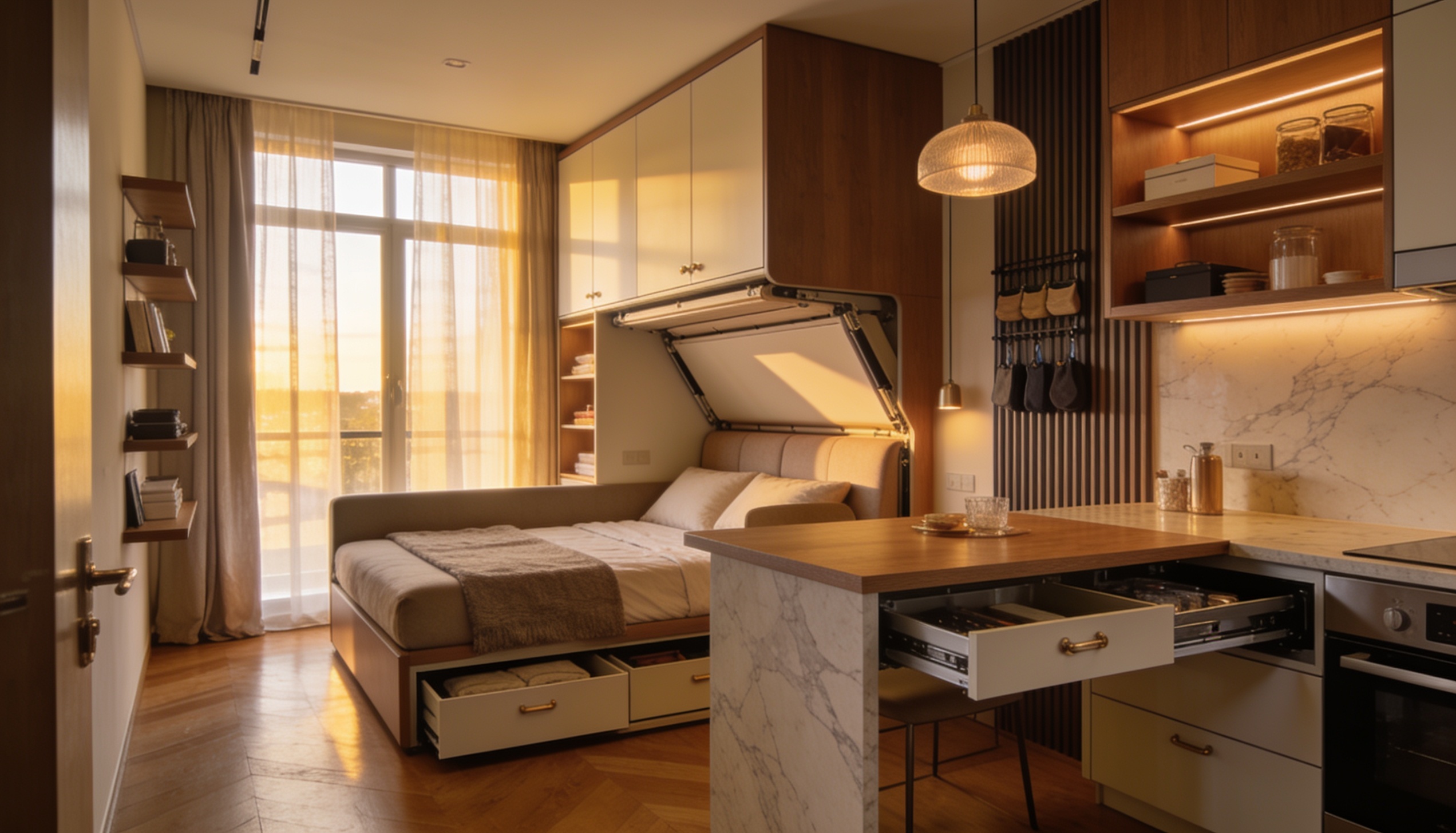
Living in a 350-square-foot studio and feeling like you are tripping over furniture? You are not alone. More and more people live in small apartments, and the pressure on every square foot is higher than ever. The solution is not to move — it is to choose pieces that do more than one thing. In 2026, transformable furniture has come to dominate design fairs, and it is not just about Murphy beds anymore.
What transformable furniture means and why it is the solution for small spaces
Transformable furniture is a piece that changes its function with a simple gesture. A table becomes a wall, a bed turns into a desk, a sofa expands into a double bed. In small apartments, where a studio averages 300–350 square feet and a one-bedroom rarely exceeds 550, every piece of furniture counts double.
Interior architects recommend multifunctional furniture especially in new builds, where rooms are small and often combine the living area with the kitchen. A Murphy bed — the kind that folds up into the wall — frees up 40–50 square feet during the day. That is enough room for a desk or a dining table for four.
7 transformable furniture pieces that change your home
Among all the solutions on the market, seven pieces stand out for solving specific small-space problems:
-
Murphy bed (wall bed). The most well-known type of transformable furniture. It mounts inside a cabinet or directly on the wall and folds completely flat during the day. Modern models come with built-in shelves or a fold-down desk in the same structure. Prices in 2026 start at around $500 for a basic kit and go up to $1,800 for versions with integrated storage.
-
Foldable extendable table. Not your grandmother’s little folding table. Current models collapse to 4 inches thick and mount on the wall like a board. Open it when guests come over, close it when you need floor space. Some come with folding chairs built into the same unit, saving even more room.
-
Sleeper sofa with storage. The classic, upgraded. 2026 models have large drawers under the seat and fold-down armrests that become side tables. If you choose one with a click-clack mechanism, you set up the bed in 10 seconds without moving the cushions.
-
Desk built into a cabinet. A regular-looking cabinet hides a full desk that slides out. When you finish working, close the doors and the room becomes a living space again. An architect quoted by Lovedeco says custom furniture for small spaces is the key solution in apartments with unusual layouts.
-
Coffee table that rises to dining height. A standard 32x32 inch coffee table transforms via a gas-lift mechanism into a dining table for 4–6 people. Height adjusts smoothly, and the lower shelf hides magazines, remotes, and other small items.
-
Loft bed with desk underneath. Ideal for a child’s room or a studio. The bed is on top, with a full desk and shelves below. Some models also include a small sofa underneath. Each level serves a different function, making the room work like two separate spaces.
-
Wall-mounted fold-down stools and seats. The simplest transformable pieces. Mount them on the wall next to your table, flip them down when needed, and fold them back up after. They take up zero floor space. Versions with built-in cushions and backrests are available for extra comfort.
How to choose transformable furniture without getting it wrong
Not everything that transforms is worth buying. Before you purchase, think about three things.
The mechanism matters most. Poor hinges or a cheap folding system will cost you nerves after a month. Check the mechanism type: gas-piston systems are the safest and quietest. Mechanical spring systems are cheaper but can be noisy and dangerously fast for daily use.
The material determines how long the piece lasts. 16mm particleboard is fine only for decorative furniture. For transformable furniture — handled every day — you need at least 18mm particleboard or, preferably, 19mm MDF. The tabletop wants at least 22mm so it does not warp over time.
Think about your daily flow. A Murphy bed is only useful if you have enough floor space in front of it when it is open. An extendable table only works if you do not have to move furniture every time. Architects recommend measuring your maneuver space, not just the dimensions of the closed furniture.
Common mistakes when furnishing with transformable furniture
Many people jump into transformable furniture without considering the hidden pitfalls:
- Poor-quality mechanism. The most common regret. A cheap mechanism breaks in 6–12 months and is not worth repairing. Invest in one from a known manufacturer.
- Ignoring the weight. A Murphy bed with a full-size 54x75 inch mattress weighs 130–180 lbs total. The wall must support that, or it will come down over time.
- Bad installation. Transformable furniture requires expansion anchors into solid wall, not drywall. A regular cabinet can sit on drywall; a Murphy bed cannot. Check your wall construction before you buy.
- Underestimating the transformation time. If it takes 5 minutes to set up the bed at night and 5 to put it away in the morning, that gets annoying fast. Test the mechanism in the store at least 3 times.
- No storage plan. When the table folds away, everything on it needs somewhere to go. Plan a shelf or bin near the table.
How to maintain transformable furniture long-term
Transformable furniture needs more care than a regular piece. Lubricating the mechanisms every 6 months with silicone grease extends hinge life. Tightening screws every 3 months prevents the play that leads to accelerated wear.
Cleaning is easier if you choose washable materials. A laminate top wipes clean with a damp cloth and mild soap. Avoid alcohol or solvents that damage the top layer. For upholstery on sleeper sofas, use a steam cleaner once a month. That will add several years to your furniture’s life.
In 2026, transformable furniture is no longer a luxury. It is a necessity for anyone living in under 600 square feet. Choosing the right pieces lets you live comfortably even in 300 square feet, without sacrificing essential functions. It is not about how much space you have, but how you use it. Start with a single piece of transformable furniture and you will see the difference.
Related posts
7 Furniture Trends 2026 That Turn Your Home into a Sanctuary
Furniture trends 2026 — curved pieces, natural materials, and modular furniture for an authentic home. Discover how to transform your living space.
5 Visual Separation Methods Between Work and Relaxation at Home
Visual separation for your home office — 5 design methods that create visual boundaries between work and relaxation zones. Practical home office layout ideas.
7 Rules for a Bedroom That Helps You Sleep Better
Bedroom design for restful sleep — optimal temperature, relaxing colors, ambient lighting, and textile materials that turn your bedroom into a sleep sanctuary.